
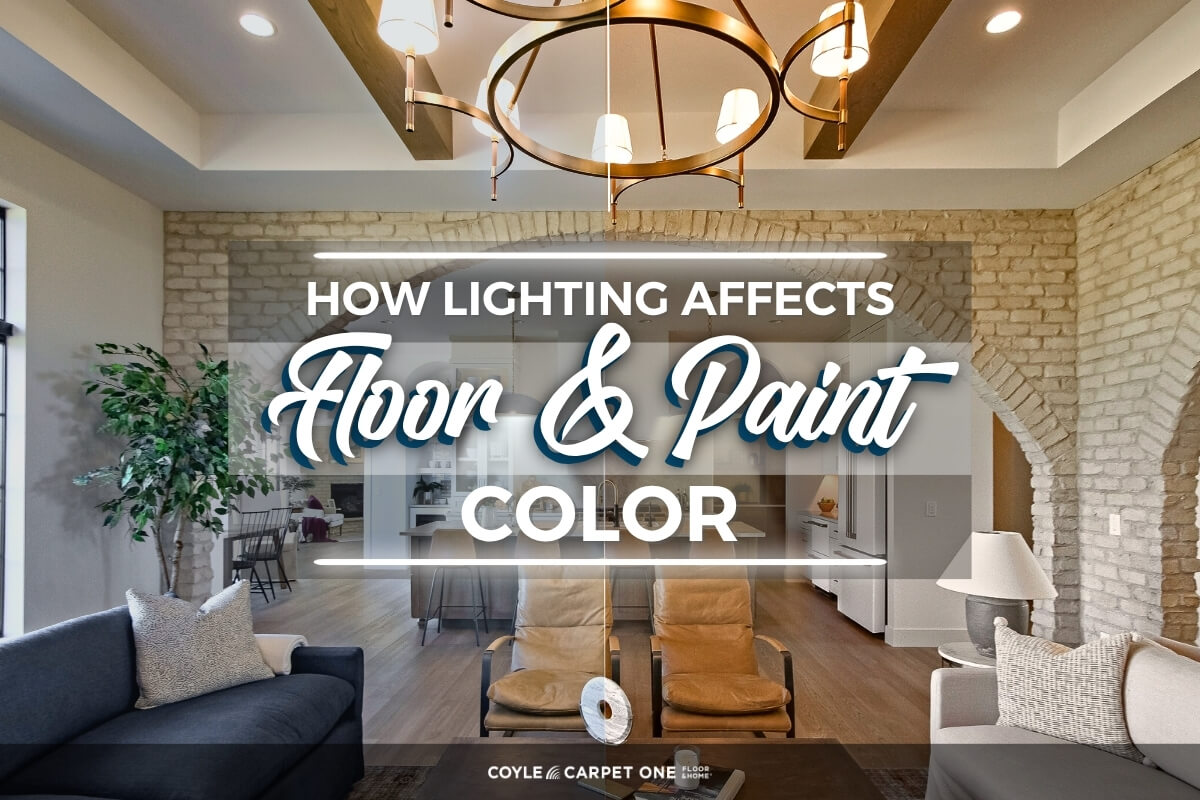
Before starting a home improvement project, it’s critical to understand how lighting affects floor and paint color perception. This article will discuss how lighting can affect the color of your floors and walls.
When thinking about home improvements, lighting is probably not the first thing that comes to mind. However, lighting, specifically the type of light bulb used, can play a significant role in the overall look you want to achieve.
It takes more than choosing the right flooring and paint colors to set the mood for a room’s interior. It’s critical to realize that a home’s natural and artificial lighting has an impact on how everything else appears. Consider both the natural and artificial lighting in your home when choosing new flooring or paint colors. Light bounces off paint and then other surfaces. As a result, the sheen of the paint (such as satin, eggshell, or glossy) can also affect the color. Matte coatings will absorb color rather than reflect it onto other surfaces. However, they aren’t always the simplest to keep clean.

Incandescent, Fluorescent, or LED Light Bulbs?
While bulb type is generally a matter of personal preference, understanding a few key differences can save you time and headaches in the long run.

LED and white incandescent light bulbs are great for providing warm, natural lighting. Bright colors (red/orange/yellow) will be slightly more intense, while cooler colors (green/blue/gray) will appear slightly duller. Keep reading to find out why lighting alters color appearance.

Emitting the brightest white light, which works best with an open interior. Fluorescent lamps save energy, but the light they emit isn’t always pleasant to work with. Fluorescent lights are also prone to flickering, which can lead to headaches in light-sensitive individuals.

Incandescent bulbs produce beautiful light but produce heat and consume more electricity. Incandescent bulbs are the most like natural light, improving the appearance of human skin, and giving warm and cozy vibes. Vintage “Edison” bulbs are even warmer than incandescent bulbs.
In the past, the incandescent vs. LED debate meant that if you wanted to replicate the color of fire, you had to use incandescent bulbs. LED bulbs can now match the color of a fireside (2700K). Using 2700K bulbs throughout your home creates a warm and cozy atmosphere. Even when compared to fluorescent lamps, LED bulbs save the most electricity.
…One of the most important decisions you’ll have to make is whether to use 3000K or 5000K color temperatures.
How Lighting Affects Floor & Paint Color
So, how do light bulbs affect paint and floor color? Two words: Color Temperature… Also known as the Kelvin Scale.
The Kelvin Scale is used to describe how a lightbulb’s output appears and exists on a scale from 1000 – 10,000 (K). Kelvin temperatures for commercial and residential lighting applications typically range from 2000K to 6500K.
- 2000K — 3000K: emits a cozy white/yellow glow (candlelight vibes)
- 3100K — 4500K: emits a radiant, cool-white light.
- 4600K — 6500K: emits a bright sunshine glow in white and blue tones.
Simply put, warmer lighting will bring out warmer tones to a floor, while cooler lighting will bring out colder tones. One of the most important decisions you’ll have to make is whether to use 3000K or 5000K color temperatures.

What color temperature will look best where?
Choose 2700K if you want natural wood finishes to take center stage. It will help wood tones look their best by providing a warm glow. Using 2700K bulbs throughout your home, especially in bedrooms, creates a welcoming and inviting atmosphere. In the kitchen and bathroom, 3000K-3300K will make things cleaner due to the added blue hues making whites brighter.
In a workshop, garage, family gym, etc., 5500K bulbs offer ample visibility for most tasks. These bulbs can also be used in laundry rooms to make whites whiter and cleaner. Retail spaces often use fluorescent bulbs in the 5000K to 5500K range. This makes choosing floor and paint colors under store lighting a bad idea. Because, often, once installed in a residential setting under warmer color temperatures, it will take on an entirely different look.

How to Make Final Floor & Paint Selections
If you plan to change your lighting to a different color temperature, ensure you view your samples in your home. Look at them under that specific lighting.
EXPERIMENT WITH LIGHTING
Morning, afternoon, and evening light can bring out different hues from flooring depending on your home’s orientation. Check your samples at different times of the day. This ensures that you can enjoy them with varying levels of light. Turn on the interior lights, as usual, to see how the samples appear at all times of the day.

Example of how the same area and flooring can look when lit with cool or warm white light.
TRY IT IN DIFFERENT ROOMS OR SPACES
Take the sample and place it in different rooms if you plan to install new flooring in more than one room. Alternatively, try it in different parts of the same room. You’ll want to see how the flooring looks in different rooms, and under different lighting.
“After a couple of days remove the samples that don’t fit your style goal.”

LEAVE THE SAMPLES IN PLACE
Take some samples of your new flooring, place them in the target space, and leave them there. It’s one thing to like flooring at first glance. However, you should let your eyes observe it for several days. Do this at night under your home’s lighting and during hours of natural light. Remember that you’ll be staring at your flooring every day. Take the time to appreciate it for longer than a few hours. Leave it for a few more days and see how you feel if you’re not feeling assured.
After a couple of days remove the samples that don’t fit your style goal. Whether it is a flooring sample or a paint sample, remove at least one from the mix. Take the time to do this as it will aid you in concentrating on the top candidates. Doing this will allow you to focus your attention on the flooring that will truly work in your space.
Ready to start a home improvement project?
LET US SEND YOU SAMPLES or drop us a line and tell us about your project!